
Digital music as we know it started one evening in 1956, when an electrical engineer named Max Mathews and his boss at Bell Labs, John R. Pierce, attended a piano recital at nearby Drew University.
Both of them liked the Schoenberg performance but hated a piece by either Artur Schnabel or Karl Schnabel (sources differ). Pierce cracked that a computer could make better music, then told Mathews to take some time away from his day job as an acoustic researcher at Bell to work on that. Mathews—born 100 years ago this month, on November 13, 1926—spent the rest of his life doing it.
On its face, Mathews’ first milestone, MUSIC I – a program that output a composition by his colleague Newman Guttman called “The Silver Scale” – was less than impressive: It was only 17 seconds long, and monophonic, and it had taken an hour for a room-size IBM 704 mainframe to generate it. But it was the first time a computer had made programmable digital sound synthesis from nothing but numbers; in digital music terms, it was the single-celled microbe that turns out to be the universal ancestor of everything that followed: digital audio workstations, plug-ins, visual programming environments (like Max/MSP, named in his honor), or – for that matter – any music on your laptop or phone. “The timbres and notes were not inspiring,” Mathews recalled four decades later, “but the technical breakthrough is still reverberating.”
Four years later, two Bell Labs collaborators made a computer sing for the first time, programming a rendition of “Daisy Bell (A Bicycle Built for Two)” for an IBM 7094 to perform, and Mathews wrote the music.
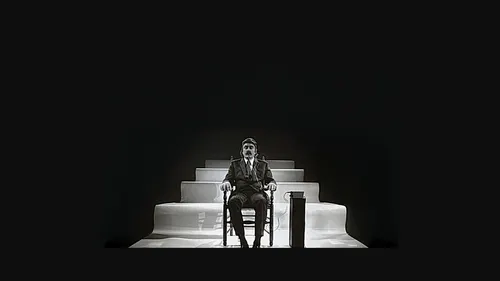
Famously, 2001 author Arthur C. Clarke heard a demonstration on a visit to Bell Labs, and the voice became the inspiration for the scene in 2001: A Space Odyssey, where HAL 9000 is disconnected and sings the same song as it loses its memory.
The shutdown of HAL 9000 in 2001: A Space Odyssey
An enthusiastic amateur violin player, Mathews was smart enough to know what he couldn’t figure out himself. He brought avant-garde composers like Jean-Claude Risset and James Tenney into Bell Labs to make computer music sound less flat. Instead of attempting to prescribe what specific instruments “should” sound like on a computer, Mathews built MUSIC III, in 1960, around “unit generators” – modular blocks of code like oscillators, filters and noise generators – giving users the power to patch together instruments of their own. That basic architecture still underpins the software synths, plug-ins and patching environments musicians use today. “The crucial thing here is that I didn’t try to define the timbre and the instrument,” Mathews later explained. “I just gave the musician a tool bag of what I call unit generators, and he could connect them together to make instruments.”
A few years later, he took that “it takes a village” ethic a huge step further when he put his work into the language FORTRAN and persuaded Bell Labs not to copyright it, effectively making MUSIC V open-source years before anybody was using that term. Accessible to anyone, MUSIC V became the foundation of the music languages that followed, including Csound, Cmix and Max.
Frustrated by the lack of spontaneity in computer music performance, Mathews spent the 1970s and ’80s working on real-time performance tools like the GROOVE system, which let a computer capture a performer’s knob-twists and keystrokes and replay them, editable, through an analog synthesizer, and the Radio-Baton, a pair of radio-transmitting batons waved over a receiver to conduct a stored digital score, steering its tempo, dynamics and balance. The Radio-Baton didn’t end up being as widespread as some of his musical inventions, but it was a forerunner of the gestural controllers Nintendo, Sony and Microsoft later brought to the mass market, such as the Wii remote and Kinect.
Max Mathews Radio Baton demonstration
Mathews was always clear that computer scientists couldn’t advance digital music on their own. Computing power, he argued, was no longer the limiting factor; our understanding of what listeners find beautiful was. “This, to me, points the road to a very interesting future, and this is not the development of more technology,” he reflected late in life, in an oral history for the Computer History Museum. “This is the understanding of the human mind and the human ear.” Moving sound generation onto a computer created infinite possibilities, but also detached music from something fundamental: instruments that resonate and push sound into human ears and minds. In a sense, after first severing that connection in 1957, he spent the rest of his career trying to stitch it back together. “The things that are worth doing are to make sounds that have the expression and beauty and emotion of real instruments,” he said in 2007, “but are different and new.”
Editor's Note: As part of the BEATL/HRZN mission we are extending opportunities to those in the emerging tech scene to write for us. Here, Nathan Brackett, Rolling Stone contributor and creator of the STEMS Substack, takes a look at the life and influence of the Father of Computer Music, Max Mathews.
Photo Credit: Kevin | CC-BY-2.0