
The 37th ISME World Conference recently took place in Montréal (July 26–31, 2026) and featured sessions on global collaboration, music technology, accessibility, and culturally responsive pedagogy.
Like all things there was a focus on Artificial intelligence, including panels on creative rights, AI tutors, generative AI tools, and curricular strategies. Also presented at the conference was a national survey of music educators’ opinions on AI. Presented by Benjamin Guerrero—a music therapist, technology researcher, member of the National Association for Music Education’s AI Task Force, and assistant professor at Eastern Mennonite University—and based on NSF grant research, the survey demonstrates early trends that are playing out across colleges and universities, including my home institution, Berklee College of Music, that largely reject “music generation,” but more easily adopt other AI use cases.
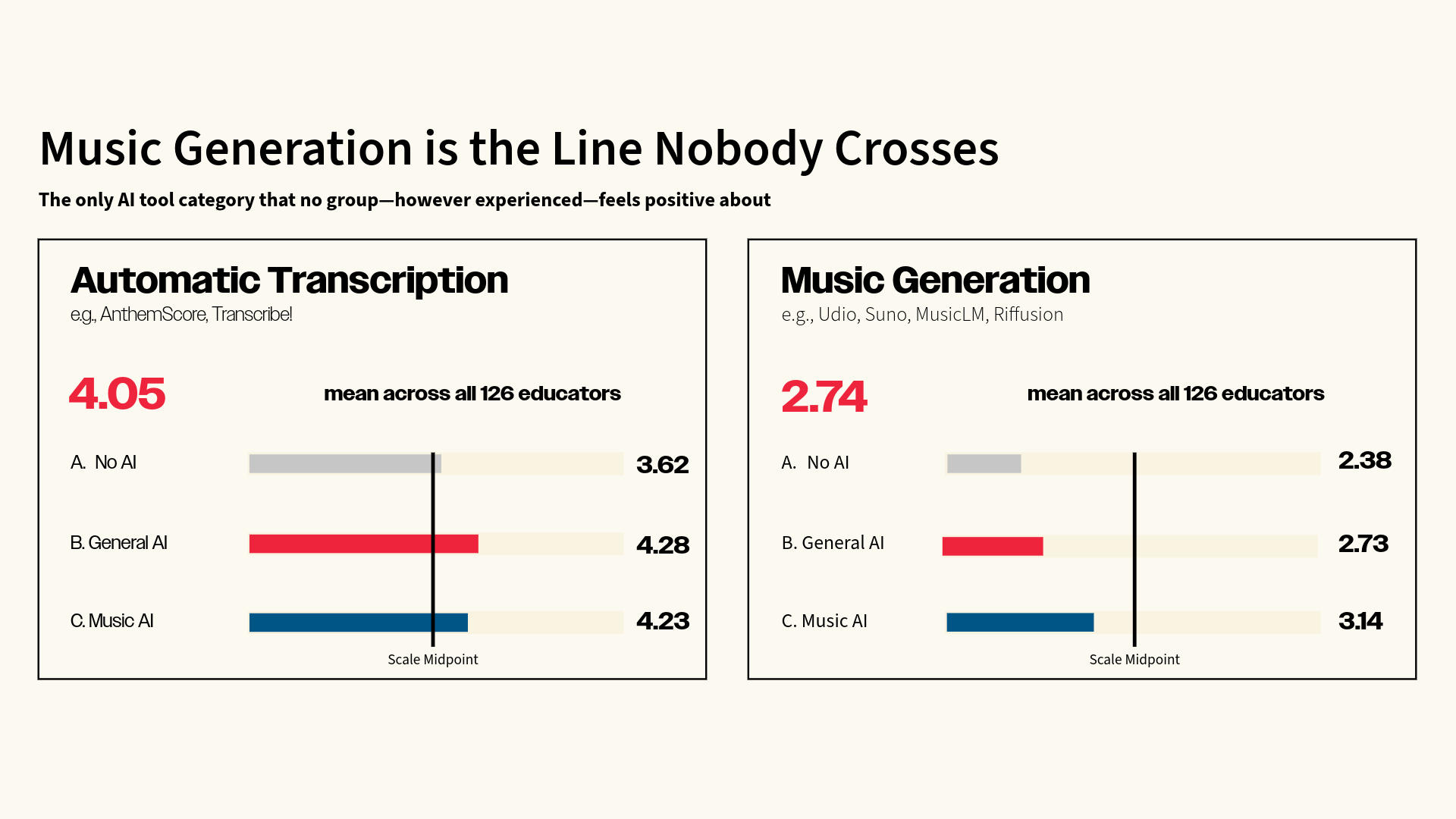
The report also mirrors a recent BEATL (Berklee Emerging Artistic Technology Lab) report in highlighting the unique demographic flip in reported data showing that younger musicians and music educators, usually at the vanguard of technological change, are more reticent about the technology than those later and perhaps more established in their careers.

The report re-enforces a widely felt belief that we remain in the early days of artificial intelligence and its impact on music and music education, perhaps best articulated in the revelation that the majority of respondents to Guerrero’s survey noted that “the music field has been ineffective in responding to AI on every topic we asked about.”
I attended the panels devoted to AI and saw five key themes that emerged across all.
Big Crowd, Small AI Presence
Roughly 1,700 educators from across the globe gathered to share their work and learn from one another. Attendees were predominantly collegiate-level faculty, alongside secondary educators and, less so, K-8 teachers.
While AI is a prevalent conversation almost everywhere you look, it had a surprisingly small footprint among the hundreds of sessions:
- 12 sessions total explicitly referenced AI in their titles or abstracts.
- 8 paper presentations took a narrow, highly specific research focus.
- 4 panel discussions explored broader topics.
- 2 workshops offered practical examples. (Interestingly, one of these workshops actually used AI as a foil to emphasize the importance of human agency and community, rather than focusing on the technology itself.)
I was left with an overall impression that while there’s an emergent awareness about various AI technologies that stand to impact creative work and pedagogy separately, many were unclear about how, or whether they even should, engage with them. Beyond that was an absence of discussions around how AI may impact the delivery and appetite for education.
I found this lack concerning as it stands to create a scenario where programs will be in a reactive mode once trends begin to emerge in these areas. In the few sessions that addressed aspects of AI head on, the presenters pointed in various ways to the potential to leverage the technology to improve the interaction and delivery of learning outcomes.
The Five Key AI Themes
The AI-related sessions clustered around the following five major themes:
- Pedagogical Adaptation & Classroom Practice: Using AI as a teaching and feedback partner, plus songwriting and practical tools.
- Policy, Ethics, and Academic Integrity: Crafting AI-resilient policies, navigating ethics, and managing publishing standards.
- Identity, Self-Expression, and Human Connection: Examining vocal and musical identity in the age of synthetic media.
- Inclusivity, Heritage, and Global Perspectives: Leveraging technology for cross-cultural and inclusive music-making.
- Creative Agency & Compositional Impact: Exploring AI through the composer’s perspective.
Across many presentations, there was a noticeable drive to "preserve and protect" traditional teaching practices. What felt largely absent was a forward-looking mindset—using tech adoption as an opportunity to re-imagine instruction and fundamentally improve student outcomes.
Experienced educators are experts in identifying competencies and learning outcomes that benefit their students, and spend years building programs and curriculum around them. The methods and delivery systems in education are highly developed for, and targeted to, an educational model. The great challenge is to separate the learning outcomes from the model in order to evaluate where and how to implement change.
On the HRZN
The overarching theme from ISME 2026 is that music education as a field is still sitting at the starting line regarding AI integration. While specialized fields like Music Therapy are embracing the technology, the broader academic community is taking a cautious, defensive posture rather than proactively rewriting curricula for the already arrived machine-assisted world.
Where does music education need to focus efforts?
- AI guidance for faculty from practical knowledge to assistance developing curriculum
- Identifying best practices and AI policies for institutions, faculty, staff, and students
- Create spaces for expert educators to explore the technology and develop opportunities to implement the technology in beneficial ways